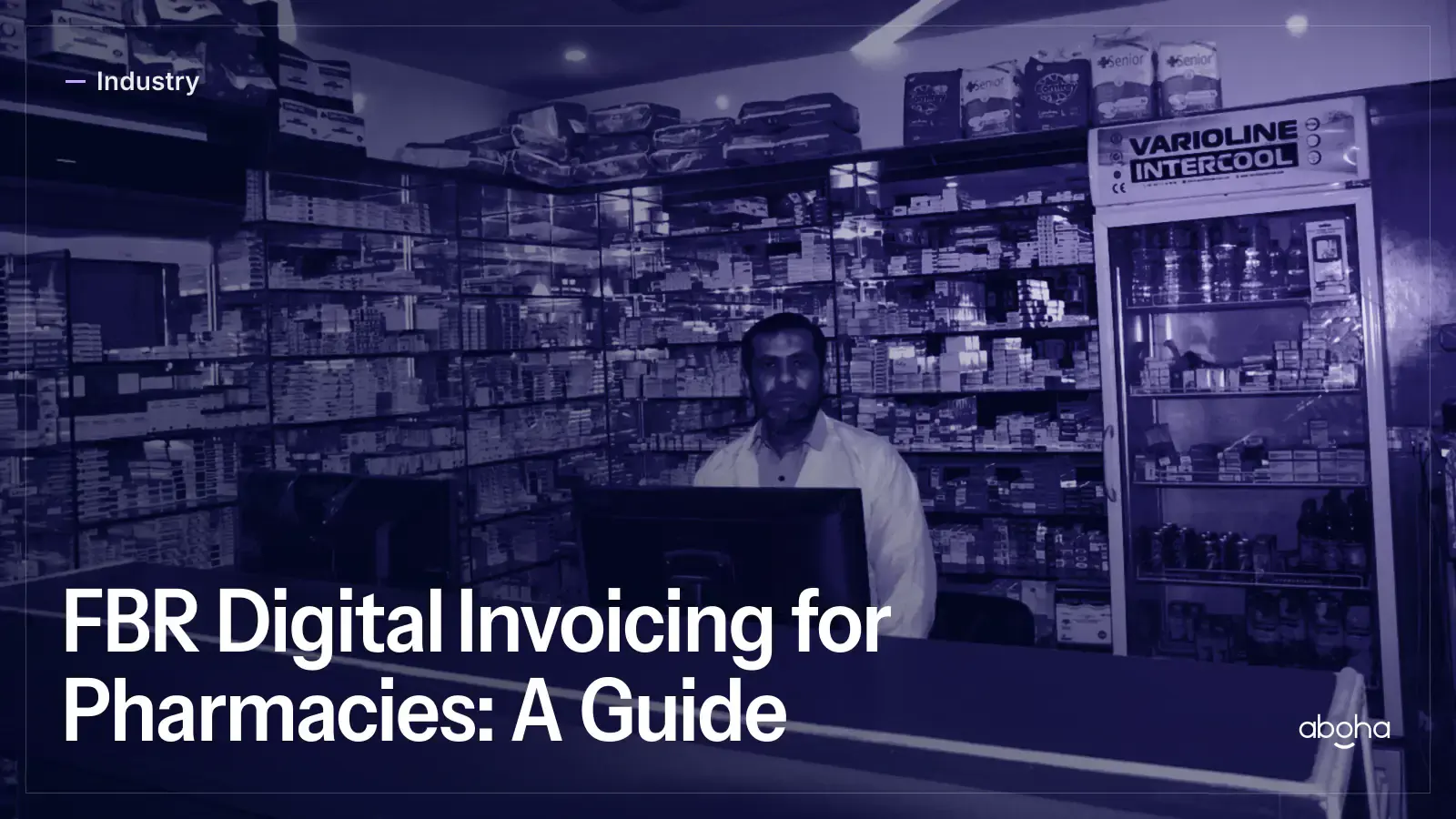
FBR Digital Invoicing for Pharmacies: A Guide
Pharmacies deal with 3rd-Schedule pricing, high transaction counts and thin margins. How to get FBR-compliant without slowing down the counter.

On this page
- Why pharmacies see this differently than other retailers
- The core failure mode: retail-price mismatch
- Speed at the counter matters too
- Insurance-panel and corporate-account billing
- Barcode and SKU data quality as a compliance prerequisite
- What to look for in pharmacy-specific software
- Getting it right without slowing down
Why pharmacies see this differently than other retailers
A pharmacy is a retailer in the most literal sense — a counter, a queue, a till — but it carries a tax complication most retail categories don't: a meaningful share of what it sells is priced under the Sales Tax Act's 3rd Schedule, where tax is charged on the retail price the manufacturer has already declared on the pack, not on whatever price the pharmacy actually sells at. That single difference is a common cause of FBR invoice rejections at pharmacy counters.
Add to that the sheer transaction volume a typical pharmacy runs — dozens to hundreds of small-ticket sales a day — and you get a business where a small, recurring data problem compounds fast. Our FBR Compliance Hub covers the digital invoicing rules generally; this post is about what specifically trips up a pharmacy counter within those rules.
The core failure mode: retail-price mismatch
When a pharmacy's point-of-sale system invoices a 3rd-Schedule medicine at a price base that doesn't match the manufacturer-declared retail price on the pack, FBR's validation rejects it — commonly surfacing as an error in the 0102 range. We've written a focused walkthrough of that specific error in our guide to fixing FBR error 0102, but the pharmacy-specific root cause is almost always the same: product master data (the declared retail price per SKU) that's stale, missing, or was never captured correctly when the item was first added to the system.
This is a data-hygiene problem before it's a software problem. A pharmacy invoicing tool that pre-checks each SKU's price base against the declared retail price before submission catches this at setup, not at the counter with a customer waiting.
Speed at the counter matters too
Because pharmacies run high transaction volume with thin per-sale margins, the software choice isn't just about correctness — it's about how much friction compliance adds per transaction. A tool that takes an extra several seconds per sale to validate, format and submit an invoice adds up to real queue time across a busy day. When you're evaluating pharmacy-specific POS and invoicing software, ask specifically how fast a standard sale completes end-to-end, not just whether it's "FBR compliant" in principle.
Insurance-panel and corporate-account billing
Many pharmacies, especially those attached to hospitals or clinics, also bill against insurance panels or corporate accounts rather than pure walk-in cash. A simple rule keeps this tidy: issue the invoice correctly at the point of sale regardless of who eventually settles the bill. Panel reconciliation and corporate invoicing happen afterwards, not instead of it. Building this sequencing into your workflow up front avoids retrofitting invoices onto sales that were recorded informally.
Barcode and SKU data quality as a compliance prerequisite
If your pharmacy's inventory system was built for stock tracking rather than tax compliance, there's a decent chance your SKU catalogue is missing exactly the fields FBR validation cares about — declared retail price, correct PCT/tariff classification, tax rate by category. Cleaning this up before go-live, rather than discovering gaps invoice by invoice, is the single highest-leverage step a pharmacy can take before switching to compliant invoicing.
What to look for in pharmacy-specific software
Generic retail POS software rarely handles 3rd-Schedule pricing correctly out of the box, because it wasn't built with pharmaceutical tax treatment in mind. When evaluating options, look for: automatic 3rd-Schedule price-base handling rather than a manual override you have to remember every time; pre-validation that catches a retail-price mismatch before submission, not after a rejection; and — given how often power and connectivity drop in Pakistan — the ability to keep selling and queue invoices during an outage rather than stopping the counter entirely.
Tasdeeq by Aboha is live today as fast counter software: take payment and print a receipt that carries its FBR invoice number and QR code. Aboha Digital Invoicing is coming soon and will check each sales-tax invoice against FBR rules before sending it.
Getting it right without slowing down
A pharmacy's whole business model depends on a fast counter — compliance has to fit into that, not compete with it. The pharmacies that make this transition smoothly clean their product master data first, choose software built for 3rd-Schedule pricing specifically, and pre-validate rather than react to rejections.
If you'd like a straight look at what FBR-integrated counter billing would take for your pharmacy's specific SKU mix and volume, contact us and we'll walk through it with you.
Frequently asked questions
Why do pharmacies get more FBR errors than other retailers?
Mainly because 3rd-Schedule medicine pricing — tax charged on the manufacturer-declared retail price rather than the sale price — is more failure-prone whenever product master data isn't clean. A mismatch between the declared retail price and the invoiced price is one of the most common rejection causes at a pharmacy counter.
Does a single-outlet pharmacy need the same integration as a chain?
The compliance obligation is similar in principle for any sales-tax-registered pharmacy. What scales with outlet count is the practical setup — multi-location POS registration, inventory sync across branches, and consolidated reporting.
Sources
This article is informational and is not tax or legal advice. Confirm your specific obligations with FBR or your tax advisor.
Related reading
Back to the blog Industry
FBR E-Invoicing for Retail Stores: A Guide
Tier-1 retailers, malls and franchise stores and FBR POS rules: what the counter needs and what to ask your tax advisor about input tax.
 Industry
Pharma Distributor FBR Invoicing: The Tax Rules
Pharmaceutical distributors face 3rd-Schedule pricing, serial-81 treatment and further tax on unregistered buyers. Here's how the pieces fit together.
 POS and retail
FBR POS Integration Requirements: Full Checklist
Windows version, card-swipe facility, encrypted transmission, incident reporting — what FBR's POS integration rules actually require, in plain terms.