Private Schools & FBR E-Invoicing: What Changed
Private schools may be in scope of FBR POS integration. What the receipt carries, the less-than-Rs 1,000 fee exclusion, and a mid-year rollout.

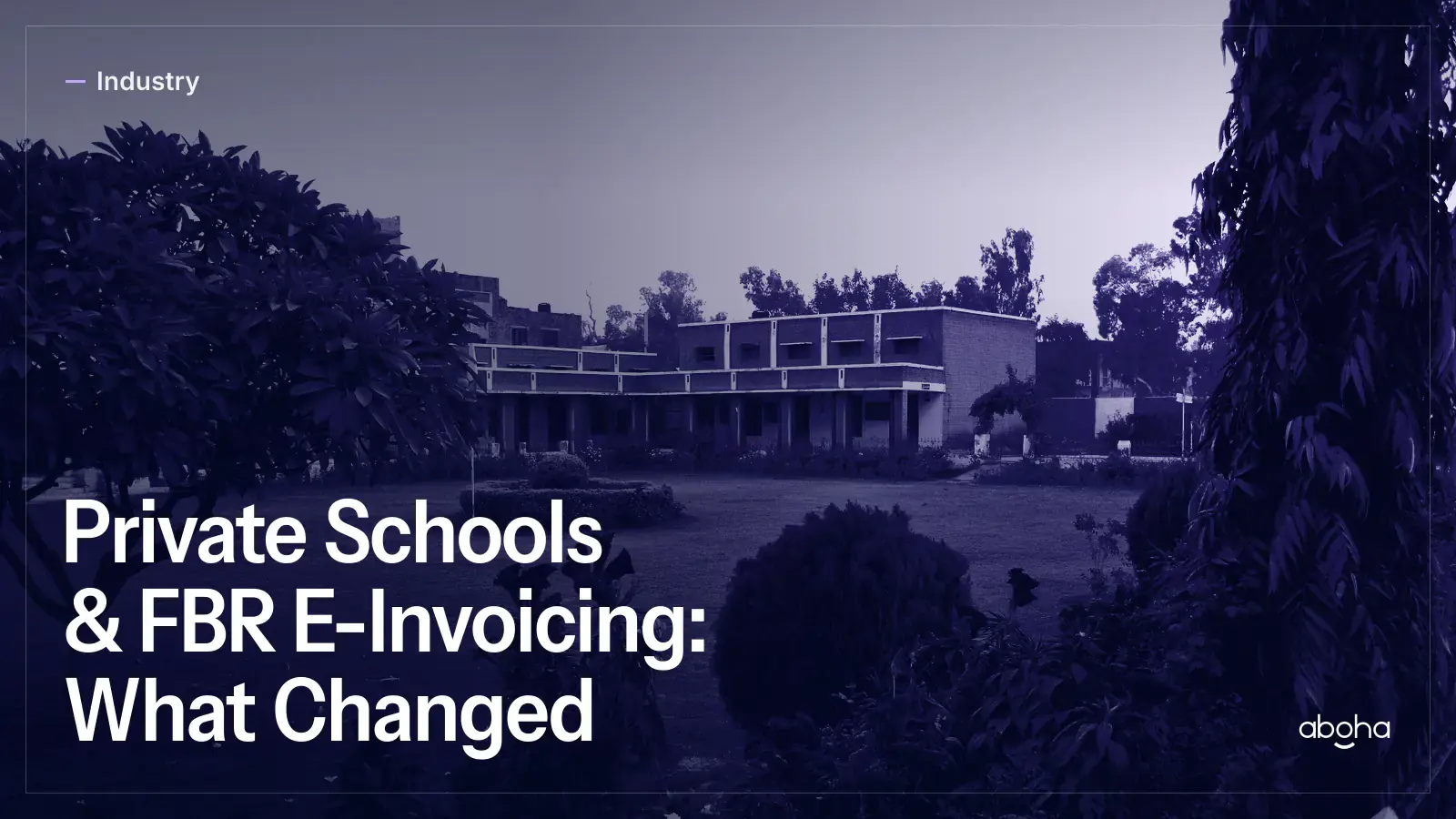
Why schools are on this list at all
Private schools, colleges and universities weren't part of the original digital-invoicing conversation in Pakistan — that started with sales-tax-registered suppliers. SRO 428(I)/2024, the final notification on POS integration under the Income Tax Rules, names private schools, colleges and universities in its schedule, with an exclusion where the fee per child is less than Rs 1,000 per month. A later draft, SRO 288(I)/2026, has not been issued as a final notification. In May 2025 the Federal Tax Ombudsman directed FBR to stop notices to educational institutions; the outcome is unknown.
Your school may be in scope. Ask us or your tax advisor, especially if you charge tuition, admission fees or other billable services and are registered for sales tax. Our FBR Compliance Hub breaks down how the different SROs stack together, which is worth reading before you assume a specific deadline either way.
What a compliant fee receipt needs to contain
If the rules apply to your school, you would not need to redesign your fee structure. The receipt you already issue would need to carry an FBR invoice reference number, a QR code and the FBR logo. Ask your tax advisor whether your school is in scope and what your receipts must show.
For a school specifically, that means every billable line — tuition, admission fee, transport, exam fee, uniform or book charges if billed through the same counter — needs to go through the same process, along with the headline monthly fee.
Recurring fees vs. one-off charges
Most schools run two very different billing patterns side by side: the recurring monthly or term fee that repeats predictably, and one-off charges — admission, re-admission, exam fees, transport for a term, a field trip — that don't. Both need a valid invoice at the point of billing, but they're worth handling differently in your system: recurring fees are a good candidate for automation once your fee schedule is set up correctly, while one-off charges tend to need a manual line item each time. Getting your fee-schedule setup right once, with correct PCT codes and tax treatment, is what makes the recurring side low-effort going forward.
Multi-campus billing and consolidated reporting
If you run more than one campus under the same institution, each billing counter may be treated as its own point of sale for FBR purposes, even though the tuition structure is shared (ask your tax advisor). That means your invoicing setup needs to register and report per campus while still giving your finance office one consolidated view for reconciliation and audit prep — not eight separate systems that don't talk to each other. This is exactly the kind of multi-branch reporting that Tasdeeq by Aboha is built to support for businesses with more than one location, and the same structure suits a school group.
Talking to parents about a new receipt format
A QR code and an invoice number appearing on next term's fee receipt is a compliance detail, not a fee increase or a policy change — but if it isn't communicated at all, it can read as one to a parent unfamiliar with what's changed. A simple approach is to send one short, factual note through their existing communication channel (the parent WhatsApp group, the school app, a line in the fee-due notice) explaining that receipts now carry an FBR verification code, full stop. No need to over-explain the regulatory backstory to parents — that's a conversation for your finance office and your tax advisor, not your fee-collection desk.
Rolling this out mid-academic-year
Schools rarely get the luxury of a clean cutover between fee cycles — a new rule, if it applies to you, may land mid-term, with the next fee collection already on the calendar. The rollouts that go smoothly share a pattern: confirm your entire fee schedule (tuition tiers, transport, exam fees, everything you actually bill) has correct tax treatment before your next collection cycle, run the new invoicing process in parallel with your existing one for the first cycle if you can, and make sure your fee-collection staff only need to learn the handful of screens they'll actually touch.
A fee counter works much like any busy counter that hands over receipts, so the operational lessons carry across. See our clinics page for how a similar counter workflow is set up.
Where this leaves your institution
Private schools are named in SRO 428(I)/2024, subject to the fee exclusion above, and may be in scope. Whether notices to educational institutions will be enforced after the May 2025 Federal Tax Ombudsman direction is worth checking with your tax advisor and at fbr.gov.pk.
For help with the counter workflow, contact us. Tasdeeq by Aboha is live today and prints a receipt that carries its FBR invoice number and QR code.
Frequently asked questions
Does this apply to small private schools, not just large chains?
You may be in scope; ask us or your tax advisor. SRO 428(I)/2024 names private schools, colleges and universities, with an exclusion where the fee per child is less than Rs 1,000 per month. Check your own fee levels against the text with your tax advisor.
Do we need to reissue past fee receipts?
If the rules apply to your school, they would apply to receipts issued going forward. Confirm any retrospective expectations for prior terms with a tax advisor rather than assuming either way.
How do we explain a new receipt format to parents without causing alarm?
A QR code and invoice number on a fee receipt is a compliance detail, not a fee change — most parents won't notice unless it's framed as one. A short, factual note in your usual fee communication channel is normally enough.
Sources
- FBR Digital Invoicing FAQs
- SRO 428(I)/2024 (22 Mar 2024) — final notification on POS integration under the Income Tax Rules
- KPMG Pakistan tax alert, Mar 2026
This article is informational and is not tax or legal advice. Confirm your specific obligations with FBR or your tax advisor.
Related reading
Back to the blog Industry
FBR E-Invoicing for Clinics: A Workflow Guide
A workflow guide to FBR e-invoicing for clinics and doctors: receipts with an FBR invoice number and QR, counter flow, patient registry, multi-branch.
 FBR compliance
Draft SRO 288(I)/2026: FBR POS Rules Explained
SRO 288(I)/2026 is a draft, not a final FBR notification. What it proposes for POS integration, how it differs from SRO 428(I)/2024, and what to check.
 FBR compliance
FBR Digital Invoicing Deadlines 2026: Full Timeline
How FBR digital invoicing phase dates moved from SRO 709(I)/2025 to 1852(I)/2025, by turnover and entity type, and how to confirm your own date.