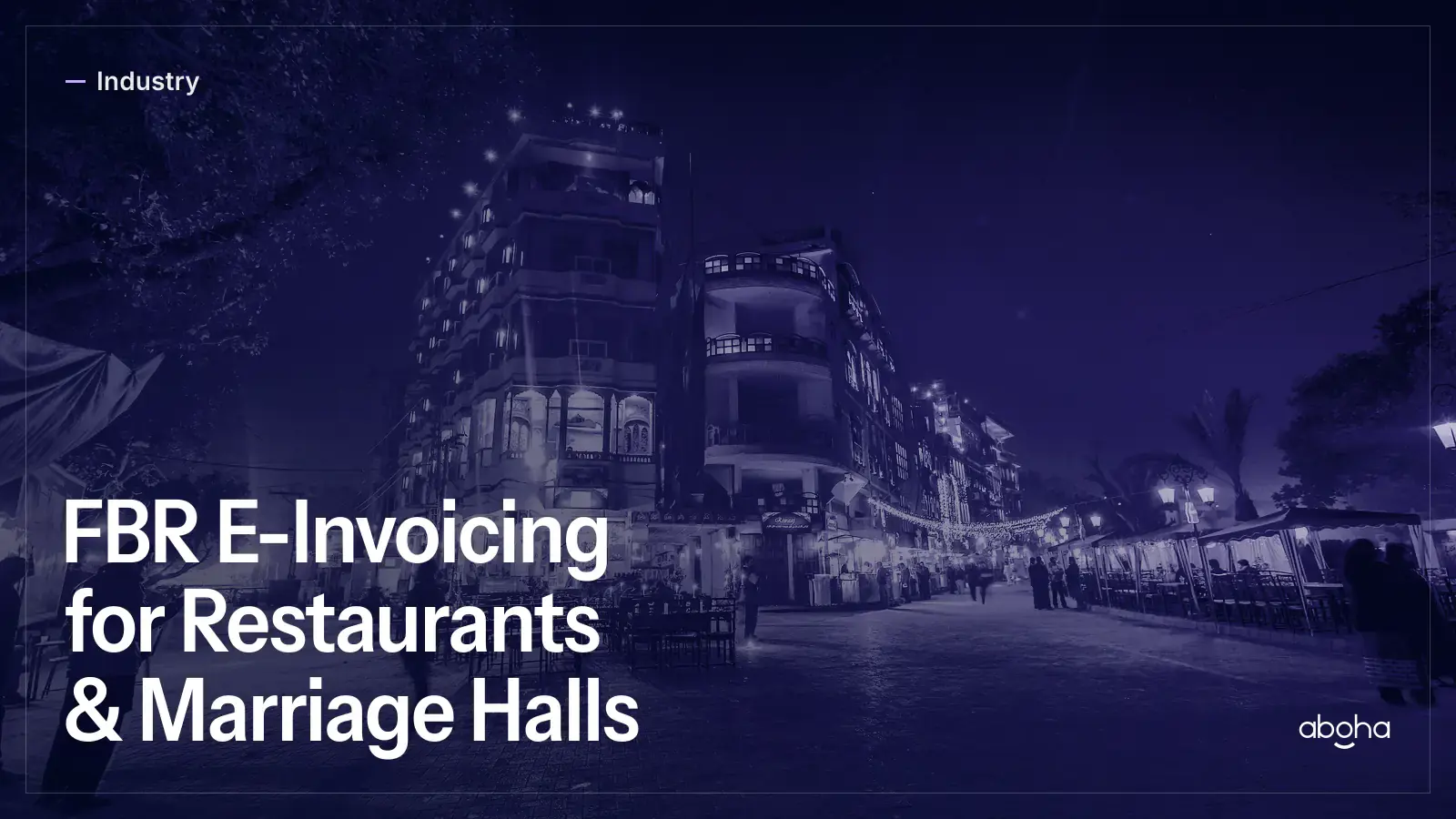
FBR E-Invoicing for Restaurants & Marriage Halls
SRO 428(I)/2024 names restaurants, hotels and marriage halls for FBR POS integration. What to check, the cash-heavy reality, and a counter workflow.

On this page
- Why hospitality is in the conversation
- Which rule you're actually under
- The cash-heavy reality nobody wants to say out loud
- Restaurants: many small invoices, fast
- Marriage halls and marquees: fewer invoices, more structure
- When the power or the internet drops
- Getting set up without disrupting service
- Penalties
Why hospitality is in the conversation
FBR's POS rules cover more sectors than large retail chains. SRO 428(I)/2024 (22 March 2024) is the final notification in force for income-tax POS integration, with integration "on and after 1st July, 2024". Its schedule names restaurants and hotels, guest houses, marriage halls and clubs, among many other sectors, with an exclusion for those "where the facility of air conditioning is not installed". Check the exact wording for your category with your tax advisor.
A separate document, draft SRO 288(I)/2026 (18 February 2026), was published as a draft for comment. FBR has not issued a final notification as of the last review, so it should not be treated as in force. Our SRO 288 explainer walks through the difference. This is the Income Tax Rules POS track, which is separate from the Sales Tax Act digital-invoicing track.
Which rule you're actually under
A restaurant or hall can be in scope for two tracks at once, and it helps to keep them apart:
- SRO 428(I)/2024 (Income Tax Rules): POS integration and sales monitoring, the notification whose schedule names your sector.
- The Sales Tax Act digital-invoicing regime (SRO 69(I)/2025 and later phase notifications): invoice reporting, if you are registered for sales tax.
The practical takeaway is similar under either: your point of sale produces a verifiable invoice at the time of sale. Ask your tax advisor which track applies to you. Our POS integration requirements guide has the full technical checklist. What follows is how that lands specifically in a kitchen and a banquet hall.
The cash-heavy reality nobody wants to say out loud
Hospitality runs on cash. A busy restaurant on a Saturday night, a hall settling a wedding bill — a large share moves in notes, not card. It's tempting to assume the rules bend for that. They do not. Real-time sales monitoring is meant to capture cash transactions that used to go unrecorded, so a cash-heavy operation is not treated as an exception.
The rules are about your business issuing a valid invoice through the system for the sale — regardless of how the customer pays. Get that framing right early and the rest is workflow, not philosophy.
Restaurants: many small invoices, fast
A restaurant's challenge is volume and speed. You're issuing invoices per table or per bill, across dine-in, takeaway and delivery, often at peak with a queue building. Each invoice needs its FBR invoice number and QR code, and each menu item needs the correct tax treatment, which your tax advisor can confirm.
The failure mode here isn't ignorance of the rule; it's a counter that grinds to a halt because the software forwards raw FBR rejection codes to a cashier mid-rush. The fix is a short checkout that keeps tax set-up out of the cashier's way. Tasdeeq by Aboha is built around that: take payment and print a receipt that carries its FBR invoice number and QR code.
Marriage halls and marquees: fewer invoices, more structure
A hall's rhythm is the opposite of a restaurant's — a handful of high-value events rather than a stream of small tickets. That doesn't lighten the obligation; it reshapes it. A typical event has more than one taxable moment:
- The booking deposit or advance when the date is reserved.
- Add-ons and adjustments as the guest count and menu firm up.
- The final settlement on or after the event.
Each of these can need its own invoice (ask your tax advisor), and the amounts are large enough that a rejection or a mismatch is a real problem, not a rounding error. The workflow that goes smoothly treats a wedding as a small account with staged invoices, rather than one cash figure reconciled after the fact. Doing it informally and trying to retrofit invoices onto a settled event later is exactly the situation to avoid.
When the power or the internet drops
Load-shedding and patchy connectivity are a daily reality for Pakistani venues, and a real-time invoicing rule collides with that head-on. The wrong response is a till that simply can't process a sale when it can't reach FBR — leaving you to turn away a paying customer or scribble the bill on paper.
The right response is software that keeps working through the interruption: capture the sale locally, keep serving, and submit to FBR the moment connectivity returns (ask your tax advisor whether any time window applies to offline invoices). Our guide to offline POS during load-shedding covers how that queuing and delayed sync should work so records catch up quietly in the background.
Getting set up without disrupting service
A few steps make the rollout calm rather than chaotic:
- Confirm your category and status. Check whether your specific type of establishment (and the air-conditioning exclusion) is in scope, with your tax advisor.
- Map your menu or event package to correct tax treatments before go-live, so nothing bounces at the counter.
- Plan for offline given real-world power and internet, rather than assuming stable connectivity.
- Plan for records. QR-coded receipts and record keeping are part of the counter routine; ask your tax advisor what else applies.
- Train staff on the few screens they touch, not the whole compliance picture.
Penalties
Penalties apply for failing to integrate. See the FBR compliance hub for the statutory text and ask your tax advisor how it applies to your business.
If you run a restaurant, hall or guest house and want a straight read on what a disruption-free rollout looks like, contact us and we will map the counter side with you. Legal questions go to your tax advisor.
Frequently asked questions
Does a cash-only restaurant or hall still have to issue FBR invoices?
The rules attach to your business issuing a valid invoice through the system, not to how the customer pays. Real-time monitoring is designed to capture cash sales too. Ask your tax advisor how this applies to your business.
Are all restaurants and halls covered, or only air-conditioned ones?
SRO 428(I)/2024 names restaurants and hotels, guest houses, marriage halls and clubs, with an exclusion where the facility of air conditioning is not installed. Check the exact wording for your category with your tax advisor.
What about a marriage hall that only holds a few events a month?
Low volume changes the workflow, not the rules. A hall issues an invoice per event, often per booking deposit and final settlement, instead of dozens of small tickets a day like a restaurant. Ask your tax advisor how staged payments are treated.
Sources
This article is informational and is not tax or legal advice. Confirm your specific obligations with FBR or your tax advisor.
Related reading
Back to the blog FBR compliance
Draft SRO 288(I)/2026: FBR POS Rules Explained
SRO 288(I)/2026 is a draft, not a final FBR notification. What it proposes for POS integration, how it differs from SRO 428(I)/2024, and what to check.
 POS and retail
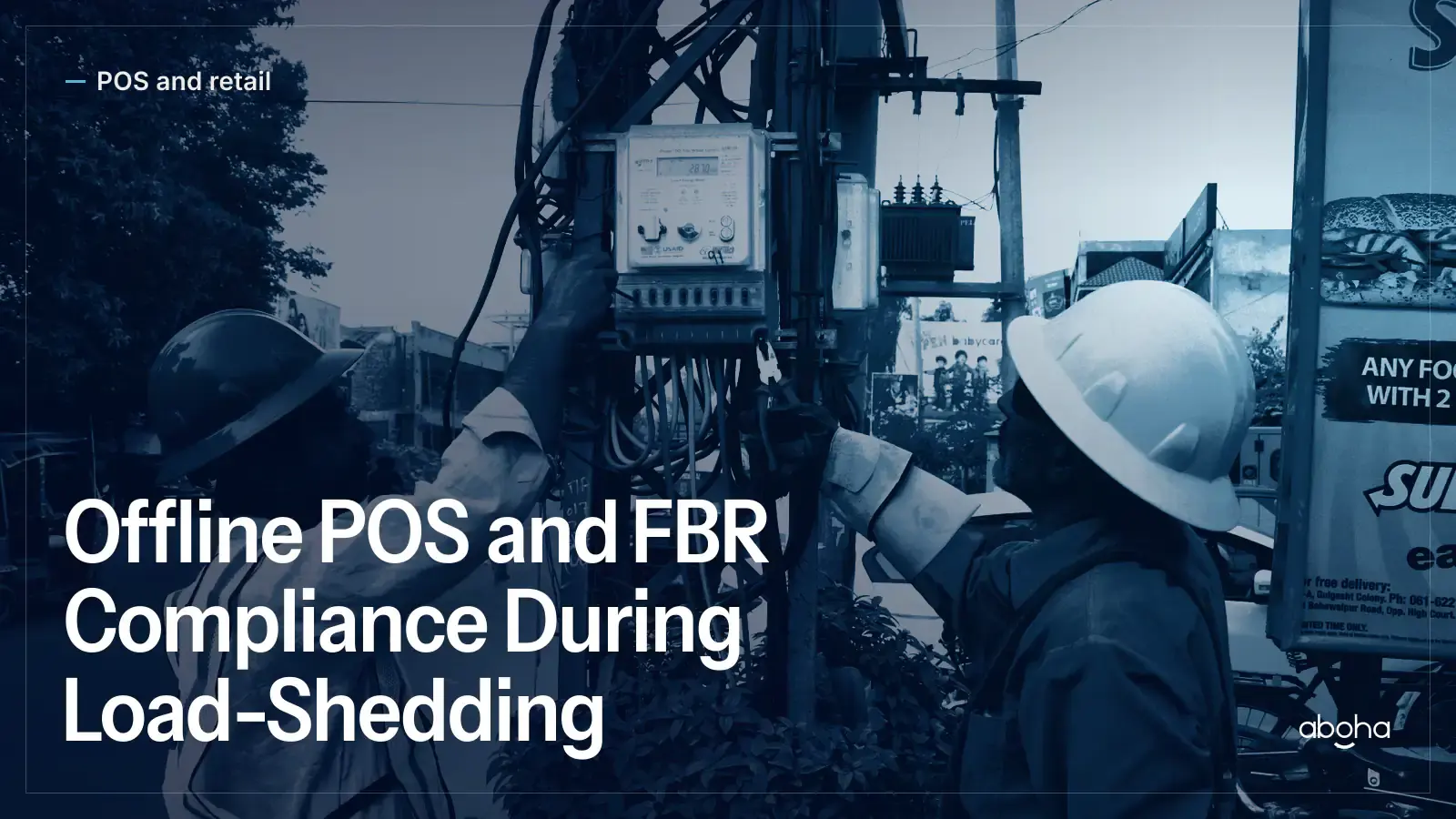
Offline POS and FBR Compliance During Load-Shedding
Load-shedding and dropped internet don't pause sales. How offline-capable POS keeps you selling and still gets invoices to FBR once you're back online.
 POS and retail
FBR POS Integration Requirements: Full Checklist
Windows version, card-swipe facility, encrypted transmission, incident reporting — what FBR's POS integration rules actually require, in plain terms.