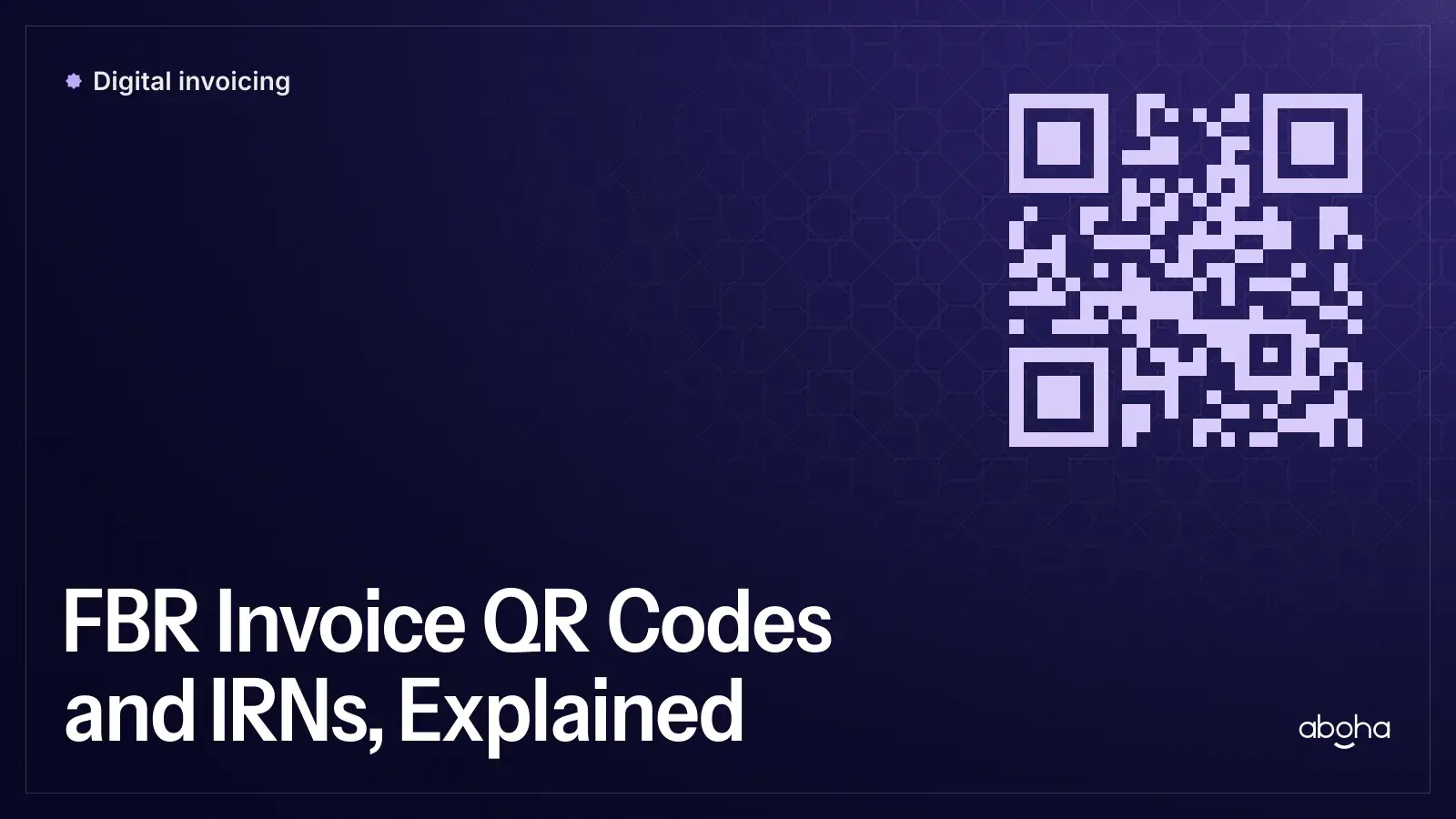
FBR Invoice QR Codes and IRNs, Explained
What's actually inside an FBR invoice reference number and QR code, why both are legally required, and how a buyer can verify one is genuine.

On this page
- The three things a compliant invoice must carry
- What's actually inside an IRN
- How the QR code gets generated
- Why missing any one of the three invalidates the invoice
- What this means for your invoice or receipt template
- A buyer's-side view: spotting a fake or non-compliant invoice
- A note on receipts vs. formal invoices
- Where errors tend to show up
The three things a compliant invoice must carry
A legally valid FBR invoice needs three specific elements together: an FBR invoice reference number (IRN), a QR code, and the FBR Digital Invoicing logo. This isn't a stylistic suggestion — a document missing any one of the three is not a valid invoice under the current rules, no matter how complete or professional it otherwise looks. This anatomy traces back to SRO 69(I)/2025, the legal root of the digital-invoicing regime; see our FBR Compliance Hub for the full rule stack this sits under.
What's actually inside an IRN
The IRN is a unique reference number — roughly 22 characters — that FBR generates and returns for each specific invoice once it's submitted and validated. It isn't something your software makes up locally; it comes back from FBR's system as part of the validation response, which is exactly why an invoice can't have a "real" IRN unless it actually went through FBR's process.
Practically, this means your invoice number and your IRN are two different things. Your invoice number is whatever your own system assigns for internal tracking; the IRN is FBR's independent confirmation that this specific invoice was submitted and accepted. Software that just prints a made-up-looking code and calls it an IRN — without an actual round trip to FBR — isn't producing a compliant invoice.
How the QR code gets generated
The QR code is generated as part of the same validated response — it isn't something you or your software creates independently ahead of time. Scanning a genuine one should route to a verification response confirming that specific invoice was actually submitted through FBR's system. That's the entire point of the QR code: it turns "trust me, this is a real invoice" into something anyone can independently check in a few seconds.
Why missing any one of the three invalidates the invoice
It's tempting to think of the IRN, QR code, and logo as nice-to-have proof of compliance rather than strict requirements — they aren't. Current rules treat all three as required together. A document with a QR code but no IRN, or an IRN with no scannable QR, isn't a partial compliance win; it's a non-compliant invoice, with the same legal consequences as skipping digital invoicing altogether, including the risk that your buyer can't claim input tax on it. Ask your tax advisor how this applies to you.
What this means for your invoice or receipt template
If you're designing (or redesigning) your invoice or receipt layout, all three elements need dedicated, legible space — not squeezed into a corner as an afterthought. The QR code specifically needs to be large enough and clean enough to actually scan reliably at a checkout counter or on a printed receipt; a QR code that's technically present but too small or low-resolution to scan defeats its purpose. For a full field-by-field rundown beyond just these three elements, see our checklist of what belongs on a compliant FBR receipt.
A buyer's-side view: spotting a fake or non-compliant invoice
If you're on the receiving end of an invoice — as a business claiming input tax, or simply as a customer — these three elements are your quickest check. No IRN, no QR code, or a QR code that doesn't scan to a real FBR verification response, are all signals worth asking about before you accept the invoice as valid. We cover the actual verification steps in more depth in our guide to verifying an FBR invoice QR code.
This matters more than it might seem: B2B buyers may refuse invoices that don't check out, precisely because a non-compliant invoice can cost them their own input-tax claim. If you're the one issuing invoices, that buyer behavior is a strong reason to get this right — to keep your invoices acceptable to the customers who matter most to your revenue.
A note on receipts vs. formal invoices
The same three-element rule applies whether you call the document an "invoice" or a "receipt." The label on the paper doesn't change what the rules ask of it: if the issuing business is covered by digital invoicing, a till slip or a fee voucher is treated the same way as a formal invoice. Whether the rules cover your business is a question for your tax advisor.
Where errors tend to show up
If your invoices are being rejected before an IRN or QR code is even generated, the problem is almost always upstream — a validation failure FBR caught before the invoice could be confirmed. Our complete guide to FBR invoice error codes walks through the most common causes.
Tasdeeq by Aboha is live for counter sales: it prints a receipt carrying its FBR invoice number and QR code. Aboha Digital Invoicing is coming soon for sales-tax invoices. If you want to see what an FBR-verified receipt looks like on your own counter, contact us and we'll walk you through it.
Frequently asked questions
Can I generate my own QR code instead of FBR's?
No. The QR code must be issued as part of the FBR-validated response for that specific invoice, not generated independently — a self-generated code that looks similar isn't proof of anything.
What happens if a customer scans the QR and it doesn't verify?
That's a strong signal the invoice wasn't actually submitted or validated by FBR — treat it as a compliance red flag, not a cosmetic issue, whether you're the buyer or the seller.
Is the IRN the same as an invoice number my software already generates?
No. Your software's internal invoice number is for your own tracking; the IRN is a separate, FBR-issued reference that only exists once FBR has actually validated that invoice.
Sources
This article is informational and is not tax or legal advice. Confirm your specific obligations with FBR or your tax advisor.
Related reading
Back to the blog POS and retail
How to Verify an FBR Invoice QR Code
Every FBR-verified invoice carries a QR code anyone can scan. How verification works, and what a failed or missing check can mean.
 FBR compliance
FBR Invoice Error Codes: The Complete Guide
The main categories of FBR digital invoice error (auth, schema, QR, tax-mismatch) explained in plain language, with what usually fixes each one.
 POS and retail
What Belongs on a Compliant FBR Receipt
IRN, QR code, FBR logo, tax breakdown — a field-by-field checklist for what a legally valid FBR-compliant receipt or invoice must actually show.